How Sync Licensing Can Give a Song a New Life: “Unloyal” Featured in Netflix’s A Different World
A song’s commercial life does not necessarily end when its original release cycle is over.
Years after a record first reaches listeners through streaming platforms, radio, playlists, and social media, it can find an entirely new audience through television, film, advertising, games, trailers, and other forms of visual media.
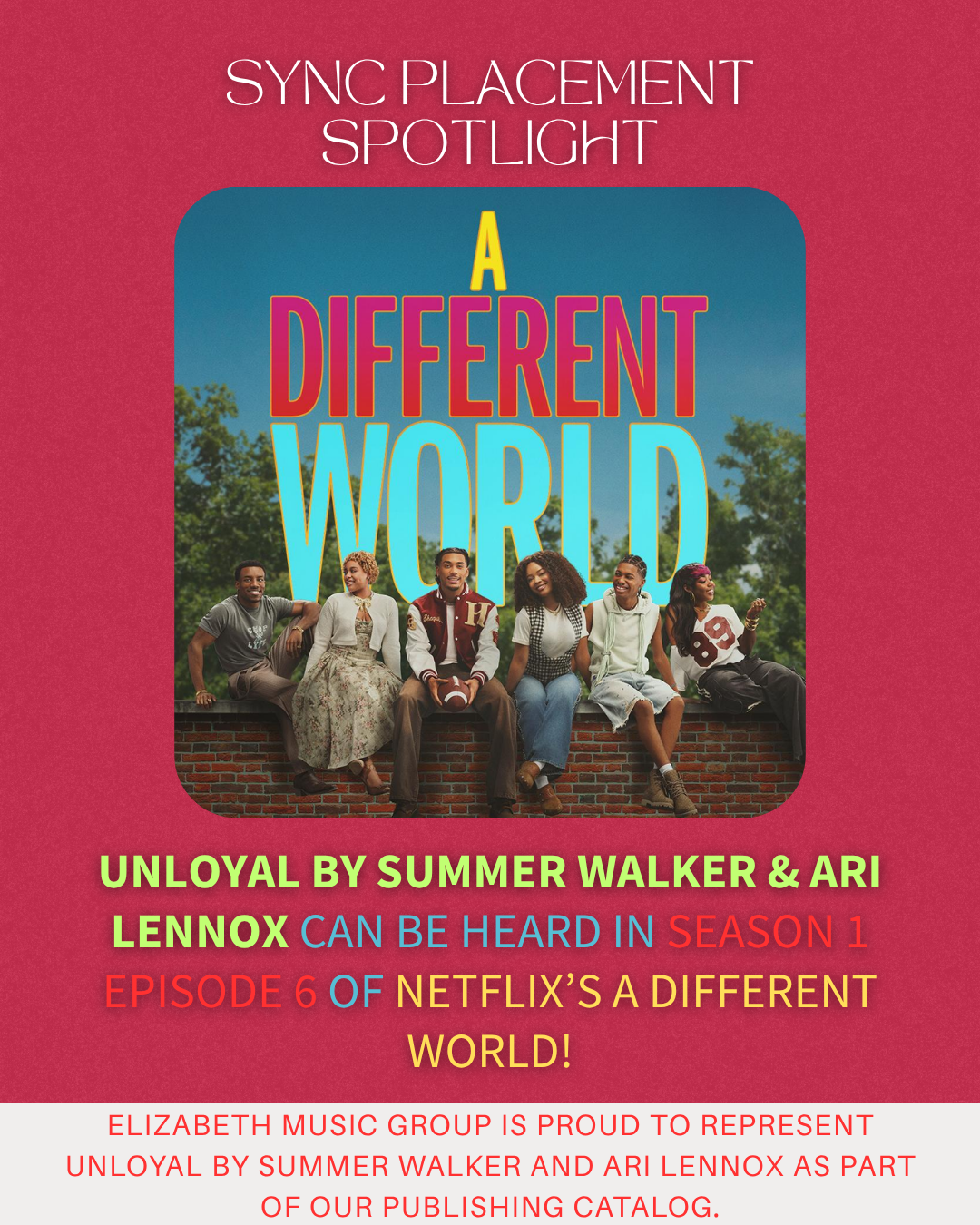
One recent example from the Elizabeth Music Group Publishing catalog is “Unloyal” by Summer Walker and Ari Lennox, which can be heard in Season 1, Episode 6 of Netflix’s A Different World.
The placement is particularly exciting because of the audience surrounding the new series. Netflix officially released A Different World on September 24, 2026. The sequel returns viewers to Hillman College with a new generation of students while bringing back characters from the original series.
Elizabeth Music Group Publishing is proud to represent “Unloyal” as part of our publishing catalog.
What Is a Sync Placement?
A synchronization, or sync, placement happens when music is licensed for use alongside visual content.
That can include television shows, movies, advertisements, trailers, video games, online campaigns, and many other forms of media.
For songwriters, producers, artists, and other rightsholders, sync represents another potential use for music beyond traditional listening.
A song does not have to be brand new to be valuable for sync.
Music supervisors and other decision-makers may search across years of released and unreleased music to find a song that fits a particular scene, emotion, character, era, or story. That means a catalog can continue creating opportunities long after individual release campaigns have ended.
Why a Television Placement Can Extend the Life of a Song
“Unloyal” originally appeared on Summer Walker’s 2021 album Still Over It. Its appearance in a new Netflix series illustrates an important concept for musicians: songs are long-term intellectual property.
When an existing song appears in a new television series, it is introduced in an entirely different context.
Someone who never discovered the record when it was originally released might hear it during a scene several years later. Existing listeners may rediscover it. Viewers may search for the song, add it to playlists, share the scene, or explore more music from the artists involved.
The original release and the sync placement therefore become two different moments in the life of the same composition.
This is one reason musicians should think about their catalogs as long-term assets rather than a collection of individual release campaigns.
Why Publishing Matters in Sync Licensing
Sync also demonstrates why properly managing music publishing rights matters.
A commercially released recording can involve multiple rights and multiple rightsholders. Broadly, there is the underlying musical composition and the sound recording, or master.
When an existing commercial recording is being licensed for synchronization, the necessary rights generally need to be cleared before the music can be used.
For the publishing side, accurate information about the composition, writers, ownership shares, and relevant representatives can make the rights picture clearer.
This becomes especially important for producers and songwriters with large catalogs.
A creator with 100, 300, or 500 released songs may have music spread across dozens of artists, labels, distributors, collaborators, and territories. Years later, one of those songs could become relevant for a television show, movie, advertisement, or another licensing opportunity.
If the underlying publishing information is incomplete or difficult to verify, that can create unnecessary complications when opportunities arise.
Your Older Catalog Still Matters
One of the biggest lessons from sync is that musicians should not focus exclusively on their newest releases.
The music business naturally encourages creators to think about what comes next: the next single, next beat, next album, next collaboration, or next placement.
Publishing requires a longer-term perspective.
A song released five years ago is still part of your catalog. So is a song released ten years ago. If people continue listening to it, performing it, broadcasting it, licensing it, or otherwise using it, the underlying composition can remain commercially relevant.
Sync can create another chapter in that lifecycle.
That is why catalog organization should be an ongoing part of a musician's business. Writers, producers, and artists should maintain accurate records of songs, collaborators, splits, release information, agreements, and other relevant metadata rather than attempting to reconstruct everything years later.
Sync Is About More Than the Initial Fee
Musicians sometimes think about sync exclusively in terms of the fee associated with licensing a song.
That is only one part of the bigger picture.
A meaningful placement can put an existing record in front of a new audience, reconnect listeners with an older release, associate the music with a memorable scene, and create additional attention around the song and the people who created it.
There can also be different royalty considerations depending on how and where the resulting program is exhibited, the rights involved, the agreements in place, and the applicable collection systems.
No individual placement guarantees a particular commercial result. The larger lesson is that properly represented music can have multiple potential revenue and discovery paths throughout its lifespan.
Building a Catalog With the Long Term in Mind
At Elizabeth Music Group Publishing, we represent more than 8,000 songs worldwide across a wide range of artists, producers, songwriters, genres, and territories.
A catalog of that size reinforces an important principle: every song should be treated as an asset with a life that may extend well beyond release day.
Some records generate most of their attention immediately. Others continue building gradually. Some can experience renewed interest years later because of a new artist connection, viral moment, interpolation, sample, television placement, film placement, or another opportunity that could not have been predicted when the song was originally created.
“Unloyal” appearing in Netflix’s A Different World is a great example of that longer lifecycle.
The series itself represents a new generation of a well-known television property. Netflix describes the sequel as returning to Hillman College with a new class while bringing back familiar characters, including Whitley Gilbert, Dwayne Wayne, Freddie Brooks, and Ron Johnson.
A song released years earlier is now part of that new chapter.
The Bigger Lesson for Songwriters and Producers
The lesson is simple: do not underestimate the future value of music you have already created.
Keep your catalog organized. Document your splits. Maintain accurate metadata. Make sure your songs are properly represented. Keep track of older releases rather than focusing exclusively on whatever you released this month.
And when appropriate, make music available for sync opportunities.
You cannot predict which song may become relevant to a music supervisor, television production, advertising campaign, or film several years from now.
The release date is the beginning of a song’s commercial life, not necessarily the end of it.
For Elizabeth Music Group Publishing, seeing “Unloyal” by Summer Walker and Ari Lennox featured in Season 1, Episode 6 of Netflix’s A Different World is a placement we are proud to highlight and another reminder of how music publishing can help songs continue creating opportunities long after their initial release.
Elizabeth Music Group Publishing
Representing 8,000+ songs worldwide.